
Research
NEW ANALYSIS REVEALS COLLISIONS 80% MORE LIKELY TO BE FATAL IN DARKNESS
Angelica Solutions analysed the Department for Transport’s road collision data and found that a collision is much more likely to result in a fatality if it occurs in the dark.
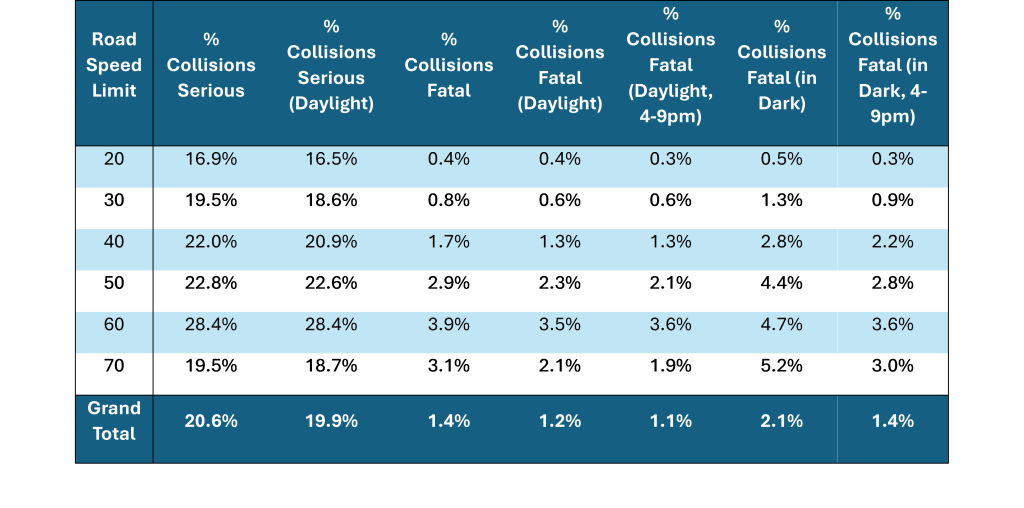
During daylight hours, 20% of injury-causing road collisions result in at least one serious injury and 1.2% result in a fatality but the proportion of fatalities rises to 2.1% in the dark, an increase of around 80% despite traffic volumes typically being much lower in the hours of darkness.
During the evening rush hour[1], collisions are 33% more likely to be fatal if it’s dark.
In any light conditions, the higher the road speed limit, the more likely a collision is to include at least one fatality – 3.5% of collisions on roads with speed limits 50mph and above result in a fatality. Light conditions have a dramatic impact here though too – with the likelihood of fatality increasing to 4.8% in the dark, a rise of around 60% compared to crashes in the light (2.9%).
Driving more slowly is the single most significant thing drivers can do to reduce the risks – we see that on 20mph roads the fatality risk increases by just under 40% in the dark, whilst the risk more than doubles[2] on 30mph and 40mph roads.
Streetlights go some way to offering protection – the data shows that during rush hour on roads with a 30mph or 40mph limit, around 22% of evening collisions result in fatal or serious injuries when streetlights were available and lit. This rises by 13% to a quarter of all evening collisions resulting in fatal or serious injuries when streetlights were not lit[3].
Sarah Vaughan, Founder & Director of Angelica Solutions comments: “Vulnerable Road users should remember the very simple ‘see and be seen’ road safety message – lights and reflective clothing are a must for any cyclists or horseriders and pedestrians would benefit from the same. It’s best to avoid unlit roads without a pavement in the hours of darkness where possible, consider alternative routes or travel plans if your journey would involve walking on higher speed roads in the dark.
“It’s not just driving risk that increases at night, a recent piece of analysis published by WHICH showed that your premiums are likely to be higher if you apply for car insurance at night too. Whilst the cheapest quotes in the analysis rose by 20%, one quote was seen to increase in price by over 100%”.

[1] Evening Rush Hour defined as 4-9pm
[2] c.109% and 117% respective increases
[3] Not lit = streetlights available but not on
Data Sources:
Collision counts from Department for Transport (DfT) Stats19 collision data – for years 2018 to 2023
https://www.data.gov.uk/dataset/cb7ae6f0-4be6-4935-9277-47e5ce24a11f/road-safety-data
Classification of injury severity within injury-based reporting systems
WHICH article on premiums based on times of day
https://www.which.co.uk/news/article/the-worst-time-of-day-to-buy-car-insurance-aWODD3h0IS5F
Data Summary:
642,719 total collisions
- 9,318 fatal; 132,358 serious; 501,043 slight
182,472 collisions in darkness
- 3,897 fatal; 40,753 serious; 137,822 slight
214,197 collisions during evening rush hour
- 2,623 fatal; 44,150 serious; 167,424 slight
86,715 collisions during evening rush hour in darkness
- 1,245 fatal; 17,909 serious; 67,561 slight
64,917 collisions during evening rush hour with street lights on
- 662 fatal; 12,917 serious; 51,338 slight
2,030 collisions during evening rush hour with street lights available but not lit
- 30 fatal; 456 serious; 1,544 slight

If you wish to use any of the graphs or data, please cite Angelica Solutions as the source of the analysis.
We specialise in data driven solutions for the insurance industry – but no matter what your business, our expertise can help you harness the power of your data.
Our team has a strong analytical background and a proven track record delivering bespoke solutions to support the business goals of our clients.
For journalists seeking to contact Angelica Solutions, kindly reach out to our press office at:
Parm PR
parm@parmpr.com
Mob: 07926197014

